Daily Reading Reflection MyCatholicLife
Disciples of Diverse Backgrounds - Friday, September 18, 2026
Jesus journeyed from one town and village to another, preaching and proclaiming the good news of the Kingdom of God. Accompanying him were the Twelve and some women who had ...been cured of evil spirits and infirmities, Mary, called Magdalene, from whom seven demons had gone out, Joanna, the wife of Herod’s steward Chuza, Susanna, and many others who provided for them out of their resources. Luke 8:1–3
Mary Magdalene, Joanna, Susanna, and “many others” faithfully accompanied Jesus and the Twelve. This diverse group of disciples defied conventional expectations. They were not the kind of followers one might ordinarily assemble when launching a mission destined to reach the ends of the earth. Yet God’s wisdom is not like our own. He perceives greatness not in social status, talent, or wealth, but in the sincerity, purity, and potential of each heart.
The inclusion of women among Jesus’ traveling companions is striking within the cultural framework of first-century Judaism. He not only welcomed them into His company but also entrusted them with meaningful participation in His mission. In doing so, He affirmed their dignity and revealed the universal scope of His call.
Even more surprising is that some of these women came from questionable or afflicted pasts. Mary Magdalene is named first: “from whom seven demons had gone out.” The number seven signifies completeness, suggesting a full and profound liberation—perhaps from both moral disorder and physical torment. Her healing reveals the immense power of divine mercy. Once bound by darkness, she became a devoted disciple, eventually standing at the foot of the Cross and witnessing the glory of the Resurrection. Her life exemplifies how gratitude for mercy can blossom into unwavering love and enduring fidelity.
Joanna, the wife of Chuza, Herod’s steward, also deserves attention. Her association with Herod’s court—a place marked by corruption—shows that the Gospel can penetrate even into environments of great moral disorder. Susanna and the many other unnamed women round out this community, highlighting a growing circle of female disciples drawn by the love and truth of Christ.
These women provided for Jesus and the Twelve “out of their resources.” Their generosity was not only material, it was spiritual. Their stewardship played a vital role in sustaining the mission of Christ. By offering what they had, they became instruments of grace, foreshadowing the ongoing collaboration in the Church between lay and ordained, men and women, rich and poor.
This early fellowship of followers models the Church in every age. They came from all walks of life: some devout, others formerly sinful; some wealthy, others of humble means; both men and women; people of high and low estate. Yet they were united in a single purpose: to follow Jesus and serve the Kingdom of God with all that they were.
Reflect today on this unexpected company Jesus formed. Many people struggle with a sense of unworthiness or feel inadequate in their spiritual lives. If you have ever felt this way, take heart in the diverse group Christ called. Their varied and imperfect backgrounds reveal the deep and consoling truth that no one is beyond being called by God. Each of us, no matter our past or present, is invited to walk with Him, to offer what we have, and to participate fully in His redemptive mission. Accept this invitation. Join this holy company. And give yourself wholeheartedly to the proclamation of the Kingdom of God.
Most merciful Lord, You always look beyond the sin to see the sinner, offering Your boundless mercy to all who turn to You in repentance. Please continue to call me to participate in Your divine mission of building Your Kingdom here on earth, so that I and all whom You touch through me may share in the eternal joy of Your Heavenly Kingdom. Jesus, I trust in You.
_______________________________________________
For more videos and reflections visit - https://mycatholic.life
*CHAPTERS*
0:00 Beginning
0:17 Scripture Quote
0:57 Daily Reflection
5:12 Final Meditation
6:17 Closing Prayer
Subscribe to My Catholic Life! - https://www.youtube.com/c/MyCatholicLifeJMJ?sub_confirmation=1
Try Our Brand New App - https://mycatholic.life/apps
_______________________________________________
*Our Social Media*
Facebook - https://facebook.com/catholic.daily.reflections
Twitter - https://twitter.com/CathDailyRef
Pinterest - https://pinterest.com/mycatholic
Tumblr - https://catholicdailyreflections.tumblr.com
Reddit - https://reddit.com/user/Catholic_Daily
Instagram - https://instagram.com/catholicdailyreflections
MeWe - https://mewe.com/p/catholicdailyreflections
Gab - https://gab.com/CatholicDailyReflections
________________________________________________
#CatholicChurch #CatholicFaith #CatholicLife
Image - https://www.flickr.com/photos/paullew/51187322382/Show More
Disciples of Diverse Backgrounds - Friday, September 18, 2026
Jesus journeyed from one town and village to another, preaching and ...
Jesus journeyed from one town and village to another, preaching and proclaiming the good news of the Kingdom of God. Accompanying him were the Twelve and some women who had ...been cured of evil spirits and infirmities, Mary, called Magdalene, from whom seven demons had gone out, Joanna, the wife of Herod’s steward Chuza, Susanna, and many others who provided for them out of their resources. Luke 8:1–3
Mary Magdalene, Joanna, Susanna, and “many others” faithfully accompanied Jesus and the Twelve. This diverse group of disciples defied conventional expectations. They were not the kind of followers one might ordinarily assemble when launching a mission destined to reach the ends of the earth. Yet God’s wisdom is not like our own. He perceives greatness not in social status, talent, or wealth, but in the sincerity, purity, and potential of each heart.
The inclusion of women among Jesus’ traveling companions is striking within the cultural framework of first-century Judaism. He not only welcomed them into His company but also entrusted them with meaningful participation in His mission. In doing so, He affirmed their dignity and revealed the universal scope of His call.
Even more surprising is that some of these women came from questionable or afflicted pasts. Mary Magdalene is named first: “from whom seven demons had gone out.” The number seven signifies completeness, suggesting a full and profound liberation—perhaps from both moral disorder and physical torment. Her healing reveals the immense power of divine mercy. Once bound by darkness, she became a devoted disciple, eventually standing at the foot of the Cross and witnessing the glory of the Resurrection. Her life exemplifies how gratitude for mercy can blossom into unwavering love and enduring fidelity.
Joanna, the wife of Chuza, Herod’s steward, also deserves attention. Her association with Herod’s court—a place marked by corruption—shows that the Gospel can penetrate even into environments of great moral disorder. Susanna and the many other unnamed women round out this community, highlighting a growing circle of female disciples drawn by the love and truth of Christ.
These women provided for Jesus and the Twelve “out of their resources.” Their generosity was not only material, it was spiritual. Their stewardship played a vital role in sustaining the mission of Christ. By offering what they had, they became instruments of grace, foreshadowing the ongoing collaboration in the Church between lay and ordained, men and women, rich and poor.
This early fellowship of followers models the Church in every age. They came from all walks of life: some devout, others formerly sinful; some wealthy, others of humble means; both men and women; people of high and low estate. Yet they were united in a single purpose: to follow Jesus and serve the Kingdom of God with all that they were.
Reflect today on this unexpected company Jesus formed. Many people struggle with a sense of unworthiness or feel inadequate in their spiritual lives. If you have ever felt this way, take heart in the diverse group Christ called. Their varied and imperfect backgrounds reveal the deep and consoling truth that no one is beyond being called by God. Each of us, no matter our past or present, is invited to walk with Him, to offer what we have, and to participate fully in His redemptive mission. Accept this invitation. Join this holy company. And give yourself wholeheartedly to the proclamation of the Kingdom of God.
Most merciful Lord, You always look beyond the sin to see the sinner, offering Your boundless mercy to all who turn to You in repentance. Please continue to call me to participate in Your divine mission of building Your Kingdom here on earth, so that I and all whom You touch through me may share in the eternal joy of Your Heavenly Kingdom. Jesus, I trust in You.
_______________________________________________
For more videos and reflections visit - https://mycatholic.life
*CHAPTERS*
0:00 Beginning
0:17 Scripture Quote
0:57 Daily Reflection
5:12 Final Meditation
6:17 Closing Prayer
Subscribe to My Catholic Life! - https://www.youtube.com/c/MyCatholicLifeJMJ?sub_confirmation=1
Try Our Brand New App - https://mycatholic.life/apps
_______________________________________________
*Our Social Media*
Facebook - https://facebook.com/catholic.daily.reflections
Twitter - https://twitter.com/CathDailyRef
Pinterest - https://pinterest.com/mycatholic
Tumblr - https://catholicdailyreflections.tumblr.com
Reddit - https://reddit.com/user/Catholic_Daily
Instagram - https://instagram.com/catholicdailyreflections
MeWe - https://mewe.com/p/catholicdailyreflections
Gab - https://gab.com/CatholicDailyReflections
________________________________________________
#CatholicChurch #CatholicFaith #CatholicLife
Image - https://www.flickr.com/photos/paullew/51187322382/Show More
An Unnamed Sinful Woman - Thursday, September 17, 2026
A certain Pharisee invited Jesus to dine with him, and he entered the ...
A certain Pharisee invited Jesus to dine with him, and he entered the Pharisee’s house and reclined at table. Now there was a sinful woman in the city who learned ...that he was at table in the house of the Pharisee. Bringing an alabaster flask of ointment, she stood behind him at his feet weeping and began to bathe his feet with her tears. Then she wiped them with her hair, kissed them, and anointed them with the ointment. Luke 7:36–38
Why did Simon the Pharisee invite Jesus to dine at his house? Though the Gospel does not tell us explicitly, the context suggests that Simon was not yet a believer or disciple. Perhaps he was merely curious about Jesus or, more cynically, sought to test or expose Him. Nevertheless, Jesus, knowing the thoughts and intentions of every heart, accepted the invitation—likely because He perceived in Simon the potential for conversion and salvation.
Traditionally, many have associated this unnamed sinful woman with Mary Magdalene, but the Scriptures do not support this identification. Others have confused her with Mary of Bethany, the sister of Martha and Lazarus, who anointed Jesus shortly before His Passion. Yet this event in Luke’s Gospel is clearly distinct, taking place much earlier in Jesus’ public ministry and under different circumstances.
Though this woman is undoubtedly a real historical person, the fact that she remains unnamed invites a deeper spiritual reflection: She represents each of us. Her anonymity makes it easier for us to see ourselves in her story. We are all sinners in need of grace. Like her, we are called to approach the Lord with humility, sorrow, and deep love. Her gestures of repentance offer a model of adoration for every contrite heart.
Her weeping, her use of her hair to wipe the Lord’s feet, and her anointing of them with costly ointment are signs of a heart overflowing with both grief and affection. In her, we see the soul that has come to understand the weight of sin and the boundless mercy of the Savior.
When we approach the Sacrament of Reconciliation, we often do so with fear and hesitation. It’s tempting to minimize or gloss over our sins. But this woman, though she says nothing, expresses everything. Her actions cry out her sorrow and longing for forgiveness. She holds nothing back, which is precisely what makes her a model for us.
Even more touching than her contrition is Jesus’ response. He does not recoil, rebuke, or reject her. He receives her, defends her, and speaks words to her that must have pierced her heart with joy: “Your sins are forgiven” and “Your faith has saved you; go in peace.”
Reflect today on this unnamed sinful woman, and try to see yourself in her. Let her humility become your own. Let her tears of sorrow become yours. Let her bold and loving gestures toward Jesus inspire you to approach Him without fear or hesitation, especially in the Sacrament of Reconciliation. No sin is too great for His mercy. If you come to Him with a contrite heart, He will not only forgive—He will elevate your soul, heal your wounds, and unite Himself to you in the deepest bond of divine love. Let her story become your own act of love and trust.
My compassionate Jesus, when a sinner approaches You with a contrite heart, Your Sacred Heart is moved with Divine Mercy. You do not hesitate to receive the repentant soul, to cleanse, anoint, and kiss it with Your love. You welcome the humble without shame or reproach. Please fill my heart with the same depth of sorrow and love shown by the sinful woman. May her tears become my own, and her boldness in love become the pattern of my life so that I also may hear You say to me, “Your sins are forgiven.” Jesus, I trust in You.
_______________________________________________
For more videos and reflections visit - https://mycatholic.life
*CHAPTERS*
0:00 Beginning
0:17 Scripture Quote
0:57 Daily Reflection
5:57 Final Meditation
6:57 Closing Prayer
Subscribe to My Catholic Life! - https://www.youtube.com/c/MyCatholicLifeJMJ?sub_confirmation=1
Try Our Brand New App - https://mycatholic.life/apps
_______________________________________________
*Our Social Media*
Facebook - https://facebook.com/catholic.daily.reflections
Twitter - https://twitter.com/CathDailyRef
Pinterest - https://pinterest.com/mycatholic
Tumblr - https://catholicdailyreflections.tumblr.com
Reddit - https://reddit.com/user/Catholic_Daily
Instagram - https://instagram.com/catholicdailyreflections
MeWe - https://mewe.com/p/catholicdailyreflections
Gab - https://gab.com/CatholicDailyReflections
________________________________________________
#CatholicChurch #CatholicFaith #CatholicLife
Image - https://picryl.com/media/artus-wolffort-feast-in-the-house-of-simon-49a1c5Show More
The Sorrow and Joy of the Gospel - Wednesday, September 16, 2026
Jesus said to the crowds: “To what shall I compare the people of this ...
Jesus said to the crowds: “To what shall I compare the people of this generation? What are they like? They are like children who sit in the marketplace and call ...to one another, ‘We played the flute for you, but you did not dance. We sang a dirge, but you did not weep.’” Luke 7:31–32
The simile Jesus uses in this teaching—“We played the flute for you, but you did not dance. We sang a dirge, but you did not weep”—portrays a generation that is spiritually unresponsive and resistant to both the joyful and sorrowful invitations of God’s grace. It may seem like a contradiction that the Gospel draws us to grace through both joy and sorrow, but both are essential movements of the heart, preparing us to receive the fullness of salvation.
Joy arises from recognizing God’s mercy, His abiding presence, and the hope of eternal life. Holy sorrow, on the other hand, is born when we confront our sin, contemplate Christ’s suffering, and acknowledge the brokenness of the world. The Gospel “plays the flute” when it invites us to rejoice in the nearness of the Kingdom; it “sings a dirge” when it calls us to repentance and conversion. A heart attuned to God responds to both—rejoicing in His blessings and weeping over sin. To ignore either call reveals a deeper hardness of heart, a spiritual insensitivity that neither celebrates divine goodness nor grieves over what separates us from it.
The context of this simile is important. After Jesus raised the only son of the widow at Nain, some of John the Baptist’s disciples, who had witnessed the miracle, returned to the Fortress of Machaerus (in modern-day Jordan), where John was imprisoned. They reported to him all they had seen. In response, John sent two of them back to Jesus to ask, “Are you the one who is to come, or should we look for another?” (Luke 7:19).
Jesus answered, “Go and tell John what you have seen and heard: the blind regain their sight, the lame walk, lepers are cleansed, the deaf hear, the dead are raised, the poor have the good news proclaimed to them. And blessed is the one who takes no offense at me” (Luke 7:22–23).
After John’s disciples departed, Jesus turned to the crowd and delivered this comparison. The children playing the flute represent the joyful proclamation of the Kingdom made manifest through Jesus’ miraculous works and message. The children singing a dirge symbolize John’s call to repentance and preparation for the Messiah. Both were divine invitations—one to rejoice, the other to mourn—and both were largely rejected by that generation.
Reflect today on the disposition of your own heart. Are you moved by the Gospel’s invitation to rejoice in the nearness of God and His blessings? Are you also willing to let your heart be pierced by the sorrow that comes from recognizing sin and the suffering it causes? Ask for the grace of a heart that is fully alive—dancing to the melody of divine joy and weeping with holy sorrow over all that hinders love. By embracing both, you will be drawn more deeply into the mystery of Christ, who came to call both the joyful and the contrite into His Kingdom.
My joyful and sorrowful Lord, at times You filled Your disciples with rejoicing; at other times, You permitted them to experience holy sorrow. Both are necessary, each accomplishing what is most needed in the moment. Grant me the grace to embrace both joy and sorrow, so that the full rhythm of the Gospel may take hold of my heart and draw me ever more deeply into Your Kingdom. Jesus, I trust in You.
_______________________________________________
For more videos and reflections visit - https://mycatholic.life
*CHAPTERS*
0:00 Beginning
0:17 Scripture Quote
0:42 Daily Reflection
5:42 Final Meditation
6:37 Closing Prayer
Subscribe to My Catholic Life! - https://www.youtube.com/c/MyCatholicLifeJMJ?sub_confirmation=1
Try Our Brand New App - https://mycatholic.life/apps
_______________________________________________
*Our Social Media*
Facebook - https://facebook.com/catholic.daily.reflections
Twitter - https://twitter.com/CathDailyRef
Pinterest - https://pinterest.com/mycatholic
Tumblr - https://catholicdailyreflections.tumblr.com
Reddit - https://reddit.com/user/Catholic_Daily
Instagram - https://instagram.com/catholicdailyreflections
MeWe - https://mewe.com/p/catholicdailyreflections
Gab - https://gab.com/CatholicDailyReflections
________________________________________________
#CatholicChurch #CatholicFaith #CatholicLife
Image - https://stock.adobe.com/images/rome-italy-august-31-2021-the-fresco-jesus-at-the-teaching-in-the-church-santa-maria-in-monticelli-by-c-mariani-1859/460161997?prev_url=detailShow More
Commingling of Love and Suffering - Tuesday, September 15, 2026
Jesus’ father and mother were amazed at what was said about him; and ...
Jesus’ father and mother were amazed at what was said about him; and Simeon blessed them and said to Mary his mother, “Behold, this child is destined for the fall ...and rise of many in Israel, and to be a sign that will be contradicted and you yourself a sword will pierce so that the thoughts of many hearts may be revealed.” Luke 2:33–35
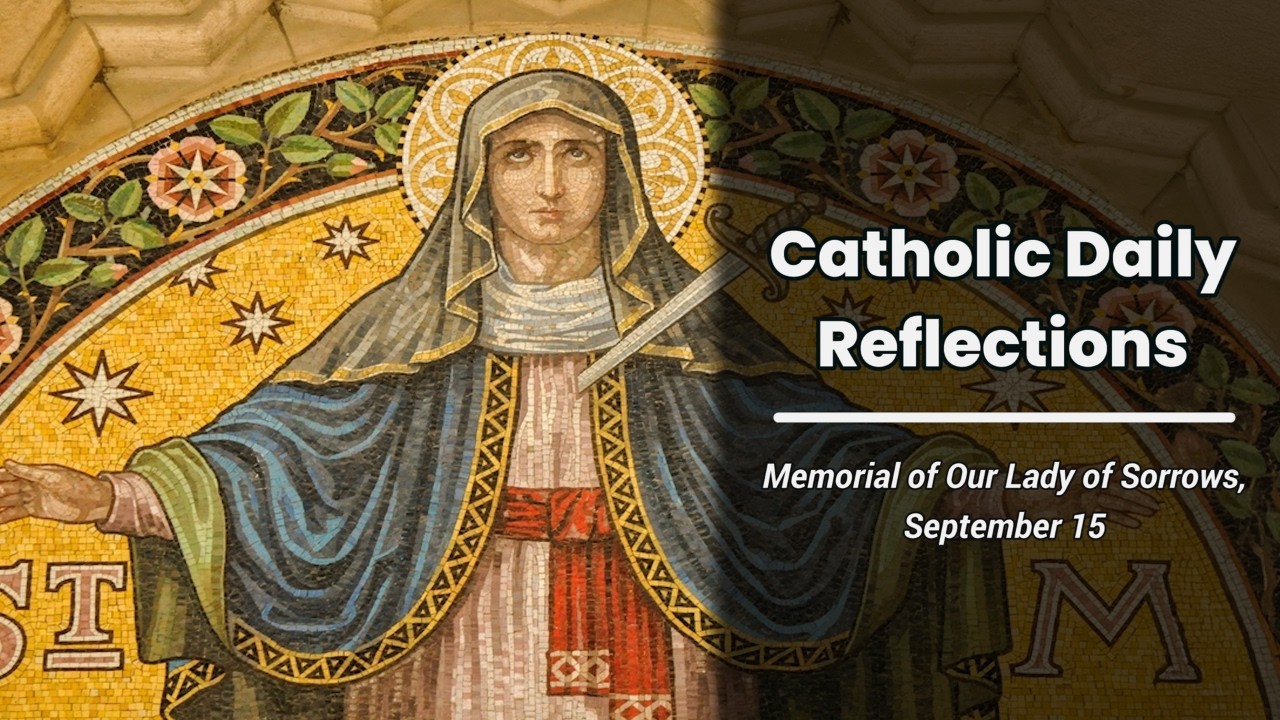
It is no liturgical coincidence that the day after we celebrate the Feast of the Exaltation of the Holy Cross, we honor Our Lady of Sorrows. This close liturgical connection highlights the inseparable union between Christ’s Passion and His Mother’s compassion.
The passage above is one of the two optional Gospel readings for today. The other is taken from the foot of the Cross: “Standing by the cross of Jesus were his mother and his mother’s sister, Mary the wife of Clopas, and Mary Magdalene” (John 19:25). In both passages, we are invited to gaze with reverent love upon the overflowing charity found in the Blessed Mother’s Immaculate Heart. Though she experienced countless moments of profound joy, today we contemplate the holy sorrow she endured as she accompanied her divine Son.
From the first moment of her Immaculate Conception, the Blessed Mother’s heart was full of grace. She was preserved from the stain of Original Sin and remained sinless throughout her life by freely obeying every prompting of the Holy Spirit who overshadowed her. For this reason, her Immaculate Heart is unique—no other motherly heart has ever loved so purely, and no other heart has ever suffered so deeply.
It is easy to imagine that pure love would exempt a soul from suffering. But all we need to do is look upon the Son of God to know that this is not so. Suffering, sorrow, and the perfection of love are not opposed; they are perfectly united in every holy soul conformed to Christ, as exemplified in His Mother.
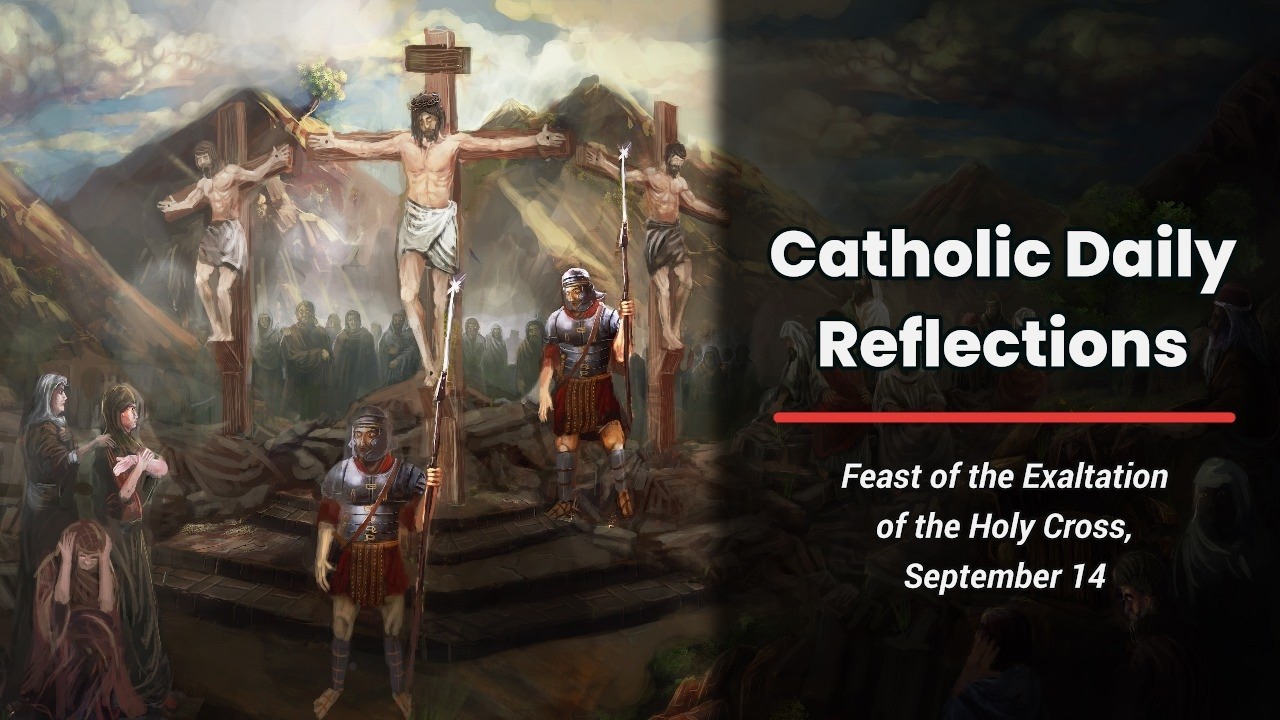
When we contemplate the Exaltation of the Cross, we behold Jesus crucified—naked, humiliated, and in excruciating agony. Yet that suffering held no power over Him. He conquered it by embracing it, enduring it, and transforming it into the very foundation of Divine Mercy.
Likewise, as the Mother of God stood before the exalted Cross of her Son and beheld Him in His final agony, her heart was pierced by the sword that Simeon prophesied on the day of Jesus’ Presentation in the Temple. In that moment, sorrow and love became one. How could she feel otherwise? Had she not loved her Son so deeply, she would not have suffered so profoundly. It was precisely because her love was so pure that her sorrow was so great.
Reflect today on the sorrow within your own heart. It is easy to be saddened by loss, hardship, or trials. But sadness is not the same as holy sorrow. Does suffering lead you to compassion and empathy, or does it turn into self-pity? As we ponder the sorrows of our Blessed Mother, pray for the grace to imitate her holy compassion. Embrace your trials with love, and allow mercy to flow from your wounded heart. The Blessed Virgin perfectly exemplifies this sacred charity, and through her intercession and example, we are called to do the same.
Our Lady of Sorrows, you stood by your divine Son in His joys and in His sufferings. You felt what He felt, loved with His love, and had compassion for all. Please pray for me, that as I gaze upon the exalted triumph of your Son’s Cross, I may never look away, but look with love, uniting my own crosses with His. Sorrowful Heart of Mary, pray for us. Jesus, I trust in You.
_______________________________________________
For more videos and reflections visit - https://mycatholic.life
*CHAPTERS*
0:00 Beginning
0:22 Scripture Quote
0:52 Daily Reflection
5:52 Final Meditation
6:47 Closing Prayer
Subscribe to My Catholic Life! - https://www.youtube.com/c/MyCatholicLifeJMJ?sub_confirmation=1
Try Our Brand New App - https://mycatholic.life/apps
_______________________________________________
*Our Social Media*
Facebook - https://facebook.com/catholic.daily.reflections
Twitter - https://twitter.com/CathDailyRef
Pinterest - https://pinterest.com/mycatholic
Tumblr - https://catholicdailyreflections.tumblr.com
Reddit - https://reddit.com/user/Catholic_Daily
Instagram - https://instagram.com/catholicdailyreflections
MeWe - https://mewe.com/p/catholicdailyreflections
Gab - https://gab.com/CatholicDailyReflections
________________________________________________
#CatholicChurch #CatholicFaith #CatholicLife
Image - https://stock.adobe.com/images/our-lady-of-sorrows-mosaic/375021467?prev_url=detail
https://stock.adobe.com/images/madonna-of-seven-sorrows/1658231435?prev_url=detailShow More
Exalting the Crucified Messiah - Monday, September 14, 2026
Jesus said to Nicodemus: “No one has gone up to heaven except the one ...
Jesus said to Nicodemus: “No one has gone up to heaven except the one who has come down from heaven, the Son of Man. And just as Moses lifted up ...the serpent in the desert, so must the Son of Man be lifted up, so that everyone who believes in him may have eternal life.” John 3:13–15
Today, as we celebrate the great Feast of the Exaltation of the Holy Cross, we are invited to ponder Jesus’ conversation with Nicodemus, “a ruler of the Jews” (John 3:1). Nicodemus was one of the few Pharisees who believed in Jesus. In many Eastern Churches, he is honored as a saint.
Nicodemus approached Jesus early in His public ministry. By that time, Jesus had called some of His Apostles, performed His first sign at the wedding in Cana, and traveled to Jerusalem for Passover, where He cleansed the Temple, declaring, “Take these out of here, and stop making my Father’s house a marketplace” (John 2:16). This was the first major public confrontation between Jesus and the religious leaders, many of whom were scandalized. Nicodemus, however, was moved by grace and came to Jesus secretly by night, saying, “Rabbi, we know that you are a teacher who has come from God…” (John 3:2). Today’s Gospel is drawn from that quiet exchange.
As their conversation unfolds, Jesus turns Nicodemus’ attention to a mysterious episode from Israel’s history, one Nicodemus would have known well. When the Israelites sinned by speaking against God and Moses, the Lord sent serpents among them. Many of the people died. But when the people repented, God instructed Moses to mount a bronze serpent on a pole; those who looked upon it in faith were healed. Jesus reveals that this ancient sign prefigured something far greater: “Just as Moses lifted up the serpent in the desert, so must the Son of Man be lifted up.”
This “lifting up” lies at the heart of today’s feast. The Exaltation of the Holy Cross is more than a remembrance of Christ’s suffering, it is a celebration of His victory. The Cross, once an instrument of Roman execution, has become the Tree of Life. Through His self-offering, Jesus conquered sin and death, transforming a curse into a blessing.
Return to Nicodemus. Having witnessed the miracle at Cana, the cleansing of the Temple, and Jesus’ powerful teaching, he was clearly stirred, yet still fearful, which is why he came at night. Imagine him hearing Jesus refer to Moses and the bronze serpent, and then saying, “So must the Son of Man be lifted up, so that everyone who believes in him may have eternal life.”
The title “Son of Man” comes from the Book of Daniel (7:13–14), in which the prophet sees the “one like a son of man” coming on the clouds of heaven to receive everlasting dominion. Jesus used this title frequently to describe Himself, linking His earthly mission with divine authority.
Reflect today on the mystery Jesus first revealed in secret. Through His exaltation on the Cross, He brings salvation to all who believe, also enabling our crosses to share in His triumph. Gaze upon the Cross with faith. What once symbolized death has become our hope, our healing, and our path to eternal life.
Most highly exalted Lord, though You spoke in veiled language when revealing Your “lifting up” to Nicodemus, You later spoke clearly as You offered Your life on the Cross for the salvation of the world. I pray that You and Your perfect Sacrifice may always be exalted in my heart—first through gratitude and praise, and then through imitation. Lift me up in every cross I carry, so that You may continue to be exalted through my life for the world to see. Jesus, I trust in You.
_______________________________________________
For more videos and reflections visit - https://mycatholic.life
*CHAPTERS*
0:00 Beginning
0:22 Scripture Quote
0:47 Daily Reflection
6:27 Final Meditation
7:02 Closing Prayer
Subscribe to My Catholic Life! - https://www.youtube.com/c/MyCatholicLifeJMJ?sub_confirmation=1
Try Our Brand New App - https://mycatholic.life/apps
_______________________________________________
*Our Social Media*
Facebook - https://facebook.com/catholic.daily.reflections
Twitter - https://twitter.com/CathDailyRef
Pinterest - https://pinterest.com/mycatholic
Tumblr - https://catholicdailyreflections.tumblr.com
Reddit - https://reddit.com/user/Catholic_Daily
Instagram - https://instagram.com/catholicdailyreflections
MeWe - https://mewe.com/p/catholicdailyreflections
Gab - https://gab.com/CatholicDailyReflections
________________________________________________
#CatholicChurch #CatholicFaith #CatholicLife
Image - https://stock.adobe.com/images/crucifixion-of-jesus-christ/197053216?prev_url=detail
https://stock.adobe.com/images/cava-de-tirreni-italy-october-7-2025-the-painting-of-the-finding-of-the-holy-cross-in-the-church-abbazia-santissima-trinita-by-nicola-maria-rossi-1690-1758/1763942007?prev_url=detailShow More
Exponential Mercy - Sunday, September 13, 2026
“That is why the kingdom of heaven may be likened to a king who ...
“That is why the kingdom of heaven may be likened to a king who decided to settle accounts with his servants. When he began the accounting, a debtor was brought ...before him who owed him a huge amount. Since he had no way of paying it back, his master ordered him to be sold, along with his wife, his children, and all his property, in payment of the debt.” Matthew 18:23–25
Jesus tells this parable in response to Peter, who asked, “Lord, if my brother sins against me, how often must I forgive? As many as seven times?” Peter likely thought he was being generous. But Jesus invited him to go far beyond what he imagined, responding, “I say to you, not seven times but seventy-seven times.”
The context is helpful. Not long before this dialogue, Jesus had changed Simon’s name to Peter—Petros—meaning “rock,” the foundation upon which He would build His Church. He further promised Peter that the gates of hell would not prevail against it and said, “I will give you the keys to the kingdom of heaven. Whatever you bind on earth shall be bound in heaven; and whatever you loose on earth shall be loosed in heaven” (Matthew 16:19).
Soon after that, Jesus took Peter, James, and John up a high mountain, where they were privileged to witness His Transfiguration—a glimpse of His divine glory. Peter had also witnessed many other miracles, some quite personal. For example, when asked by tax collectors whether Jesus paid the Temple tax, Jesus told Peter to go to the sea, cast a hook, and open the mouth of the first fish he caught. Inside, he found a coin worth twice the Temple tax—enough for both Jesus and Peter (Matthew 17:27).
Perhaps these recent events in which Peter played a privileged role left him feeling quite favored. He may have begun to think well of himself, sensing a special place in Jesus’ mission. Wanting to demonstrate his spiritual maturity, Peter made what he thought was a generous offer: to forgive his brother up to seven times.
In Jewish tradition, to forgive seven times was seen as more than sufficient. The rabbinic teaching often suggested forgiving up to three times, based loosely on interpretations of the Prophet Amos (cf. Amos 1:3). So when Peter offered seven, he was doubling that and adding one for good measure—a symbolic act of exceeding piety.
But Jesus’ response radically shifted the paradigm. Seventy-seven times—or, in some manuscripts, seventy times seven—is not a precise numerical limit. It’s a symbolic expression that conveys the idea of limitless forgiveness, echoing God’s own mercy toward sinners. Jesus was not simply raising the bar; He was inviting Peter—and all of us—into the boundless love of the Father.
Reflect today on the mercy you have received from God. Has He not been patient with you, gentle with your faults, and generous with His grace? Now consider someone in your life whom you have found difficult to forgive. Does that person’s offense compare to the debt God has forgiven you? Let this parable challenge you to a deeper conversion of heart, one that forgives as it has been forgiven, not seven times, but seventy-seven times, and more. Only then will the kingdom of Heaven truly reign in you.
Most generous Lord, You forgive more than seventy-seven times—more than seventy times seven. Your mercy is unconditional in its origin and limitless in its reach, yet it bears one condition: that I, too, show mercy to others. Grant me, dear Lord, a heart that is merciful like Yours, one that participates in and reflects Your Divine Mercy. May I forgive as I have been forgiven, so that the full debt of my sin may be wiped away and that others may be drawn to You through the witness of mercy in my life. Jesus, I trust in You.
_______________________________________________
For more videos and reflections visit - https://mycatholic.life
*CHAPTERS*
0:00 Beginning
0:17 Scripture Quote
0:52 Daily Reflection
6:02 Final Meditation
6:52 Closing Prayer
Subscribe to My Catholic Life! - https://www.youtube.com/c/MyCatholicLifeJMJ?sub_confirmation=1
Try Our Brand New App - https://mycatholic.life/apps
_______________________________________________
*Our Social Media*
Facebook - https://facebook.com/catholic.daily.reflections
Twitter - https://twitter.com/CathDailyRef
Pinterest - https://pinterest.com/mycatholic
Tumblr - https://catholicdailyreflections.tumblr.com
Reddit - https://reddit.com/user/Catholic_Daily
Instagram - https://instagram.com/catholicdailyreflections
MeWe - https://mewe.com/p/catholicdailyreflections
Gab - https://gab.com/CatholicDailyReflections
________________________________________________
#CatholicChurch #CatholicFaith #CatholicLife
Image - https://picryl.com/media/claude-vignon-parable-of-the-unforgiving-servant-5adc03Show More
The Interior Life in Action - Saturday, September 12, 2026
Jesus said to his disciples: “A good tree does not bear rotten fruit, ...
Jesus said to his disciples: “A good tree does not bear rotten fruit, nor does a rotten tree bear good fruit. For every tree is known by its own fruit. ...For people do not pick figs from thornbushes, nor do they gather grapes from brambles.” Luke 6:43–44
The interior life in Catholic spiritual theology refers to the hidden workings of God’s grace within the soul—silently yet powerfully transforming us from within so that what lies deep in the heart becomes manifest in our exterior actions. Our interior life is the foundation of who we are; our exterior life is the visible and faithful expression of that foundation.
In today’s Gospel, Jesus teaches two parables with complementary meanings—both revealing the essential connection between the interior and the exterior. The first parable, the Parable of the Tree and its Fruit, presents the image: “A good tree does not bear rotten fruit, nor does a rotten tree bear good fruit.” The “tree” is a metaphor for the soul, and the inner life of grace to which each of us is called. Though every person is fundamentally “good” by virtue of being created in the image and likeness of God, the goodness to which Jesus refers here is the goodness of a soul transformed by grace—a soul that cooperates with God’s grace and lives by His Word.
Such a soul is like a tree that receives the proper nourishment: the rain of divine mercy, the light of truth, the warmth of charity, and the rich soil of the Sacraments and prayer. It is a tree made strong by supernatural grace. But though there is great value in a tree that is healthy and vibrant—just as there is intrinsic value in a soul filled with God’s life—the ultimate purpose of a healthy fruit tree is to bear good fruit for the benefit of others.
In a sense, a fruit tree that is strong and beautiful yet bears fruit that no one consumes falls short of its purpose. Likewise, a Christian whose interior life is rich must allow that life to overflow into concrete acts of love, mercy, truth, and service. The “fruit” of our lives—our words, decisions, and deeds—must nourish those around us and draw others into the life of God. If the fruit remains hidden or is spoiled by selfishness or fear, then our interior life has not yet reached its fulfillment.
Reflect today on the foundation of your own soul. Have you dug deeply into the life of prayer, embraced the Sacraments, and allowed the Word of God to penetrate and shape every part of your being? Are you bearing fruit that nourishes others, and does your life rest securely upon the unshakable rock of Christ? The integrity of your spiritual house depends entirely on the depth and strength of your interior life.
Do not be content with surface appearances. Go deep, and allow the grace of God to make your foundation solid rock, your soul rich, your words good fruit, and your life a dwelling place that endures forever.
Lord of Grace and Truth, You continually speak to me and offer the aid of Your grace through prayer and the Sacraments. May I always listen attentively to Your Word and cooperate fully with Your grace, so that the interior life of my soul may be strong—bearing good fruit and withstanding every trial. Jesus, I trust in You.
_______________________________________________
For more videos and reflections visit - https://mycatholic.life
*CHAPTERS*
0:00 Beginning
0:17 Scripture Quote
0:42 Daily Reflection
5:58 Final Meditation
6:58 Closing Prayer
Subscribe to My Catholic Life! - https://www.youtube.com/c/MyCatholicLifeJMJ?sub_confirmation=1
Try Our Brand New App - https://mycatholic.life/apps
_______________________________________________
*Our Social Media*
Facebook - https://facebook.com/catholic.daily.reflections
Twitter - https://twitter.com/CathDailyRef
Pinterest - https://pinterest.com/mycatholic
Tumblr - https://catholicdailyreflections.tumblr.com
Reddit - https://reddit.com/user/Catholic_Daily
Instagram - https://instagram.com/catholicdailyreflections
MeWe - https://mewe.com/p/catholicdailyreflections
Gab - https://gab.com/CatholicDailyReflections
________________________________________________
#CatholicChurch #CatholicFaith #CatholicLife
Image - https://stock.adobe.com/images/st-anthony-of-padua-church-stained-glass-jesus-the-sermon-on-the-mount-vung-tau-vietnam/1748230968?prev_url=detailShow More