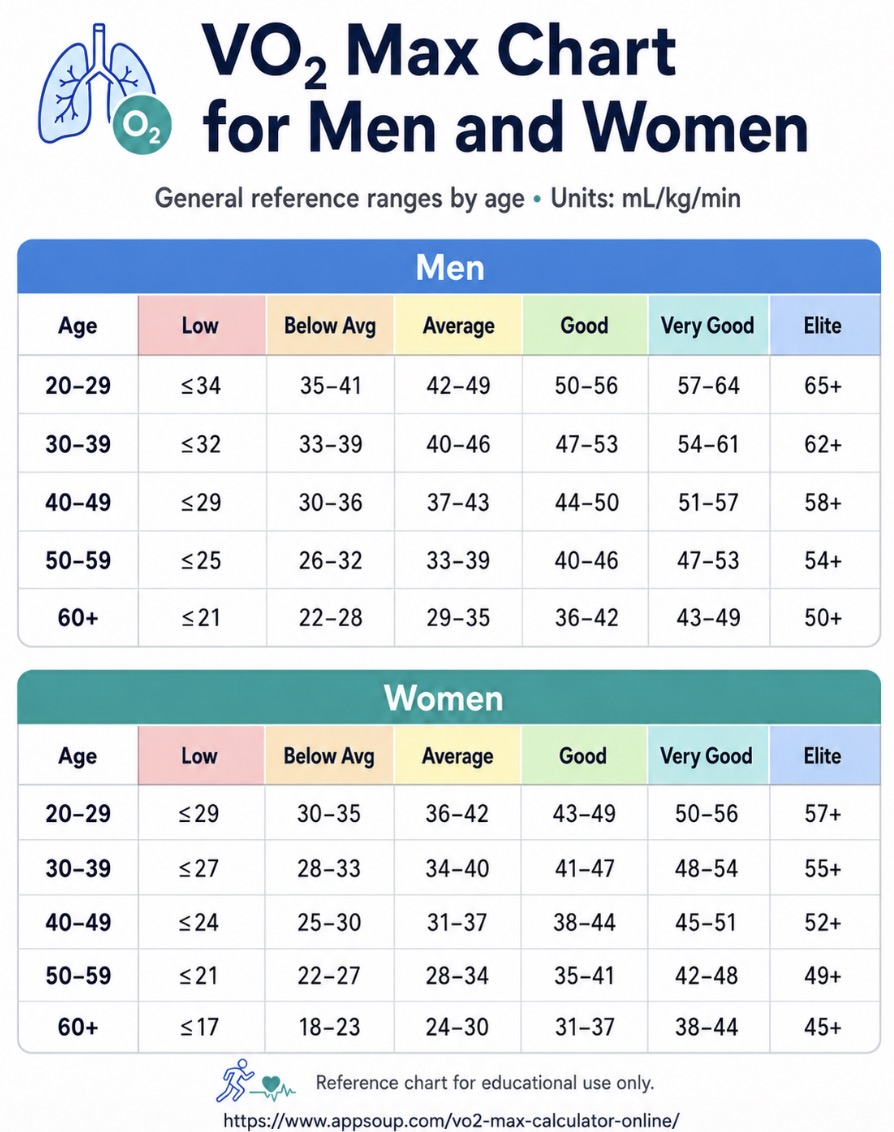
Estimate your VO₂ max using heart rate, running, or walking tests. Enter your details, compare fitness levels, and review results carefully with appropriate professional guidance. (How the VO₂ Max Calculator Works / Medical disclaimer).
Related Products:

Smart Watch Fitness Tracker with 24/7 Heart Rate, Blood Oxygen Blood Pressure Monitor Sleep Tracker 120 Sports Modes Activity Trackers Step Calorie Counter IP68 Waterproof for Andriod iPhone Women Men

Fitbit Google Air - Screenless Activity Tracker - Obsidian

WHOOP Peak - 12 Month Membership -24/7 Activity and Sleep Tracker, Personalized Coaching, Menstrual Cycle Insights - 14+ Days Battery Life
Use this VO₂ max calculator to estimate aerobic fitness using heart-rate data, a Cooper 12-minute run, a 1.5-mile run, or a Rockport one-mile walk. Enter the required age, sex, heart rate, distance, time, or weight details for your selected method. The calculator provides an estimated VO₂ max, fitness classification, and heart-rate zones. Results are estimates and should not replace laboratory testing or advice from a qualified healthcare professional or clinician.
Related Products:
Smart Watch Fitness Tracker with 24/7 Heart Rate, Blood Oxygen Blood Pressure Monitor Sleep Tracker 120 Sports Modes Activity Trackers Step Calorie Counter IP68 Waterproof for Andriod iPhone Women Men

Smart Watch for Women, Built-in Alexa, GPS, HRV, VO2 Max, Blood Oxygen, Sleep & Stress Monitor, BT Calling, Compass, Altimeter, 1.32" AMOLED, Fitness & Women’s Health, Waterproof, iPhone Compatible

Zeacool Fitness Tracker with 24/7 Heart Rate, Blood Oxygen Sleep Monitor, 123 Sports Modes Calories Smart Watch,IP68 Waterproof Step Counter Activity Trackers Health Pedometer for Women Men (Black)

Fitness Tracker, Smart Watches for Women Men with 24/7 Heart Rate/Blood Pressure/Blood Oxygen Monitor, Sleep Tracker, Calories&Step Counter, IP68 Waterproof Health Activity Trackers for Android&iPhone

Fitness Tracker, Smart Watches for Women Men with 24/7 Heart Rate/Blood Pressure/Blood Oxygen Monitor, Sleep Tracker, Calories&Step Counter, IP68 Waterproof Health Activity Trackers for Android&iPhone

MorePro Health Fitness Tracker - 24/7 Heart Rate Monitor & Activity Tracker
How the VO₂ Max Calculator Works
The VO₂ Max Calculator estimates the maximum amount of oxygen your body can use during intense exercise. VO₂ max is normally expressed in milliliters of oxygen per kilogram of body weight per minute, or mL/kg/min.
You can choose from four calculation methods. Each method uses different information to estimate your aerobic fitness level.
1. Choose an estimation method
Select one of the following methods:
- HR-based: Uses your age and resting heart rate.
- Cooper 12-minute test: Uses the distance covered during a 12-minute run.
- 1.5-mile run: Uses the time needed to complete a 1.5-mile run.
- Rockport one-mile walk: Uses your age, sex, weight, one-mile walking time, and ending heart rate.
2. Enter your age and sex
Enter your age and select your sex. These details are used to compare the estimated result with the calculator’s age- and sex-based fitness ranges.
Age is also used to estimate maximum heart rate and calculate the displayed heart-rate training zones.
3. HR-Based Method
The HR-based method first estimates maximum heart rate using the Tanaka equation:
Estimated HRmax = 208 − (0.7 × age)
The calculator then compares estimated maximum heart rate with resting heart rate:
Estimated VO₂ max = 15.3 × (HRmax ÷ resting heart rate)
Example for a 40-year-old with a resting heart rate of 60 bpm:
HRmax = 208 − (0.7 × 40) = 180 bpm
VO₂ max = 15.3 × (180 ÷ 60) = 45.9 mL/kg/min
For a more representative resting heart rate, measure it while relaxed and before exercise, caffeine, or other activities that may temporarily raise it.
4. Cooper 12-Minute Run Method
Run or walk as far as you safely can in 12 minutes and enter the total distance in meters.
The calculator uses:
Estimated VO₂ max = (distance in meters − 504.9) ÷ 44.73
Example for a distance of 2,400 meters:
(2,400 − 504.9) ÷ 44.73 = approximately 42.4 mL/kg/min
Use a measured track or reliable GPS distance when possible. Pacing, weather, terrain, fatigue, and measurement accuracy can affect the result.
5. 1.5-Mile Run Method
Enter the time required to complete a 1.5-mile run. Time must be entered as decimal minutes.
For example:
- 12 minutes 30 seconds = 12.5 minutes
- 10 minutes 45 seconds = 10.75 minutes
The calculator uses:
Estimated VO₂ max = 3.5 + (483 ÷ time in minutes)
Example for a 12.5-minute result:
3.5 + (483 ÷ 12.5) = approximately 42.1 mL/kg/min
6. Rockport One-Mile Walk Method
Walk one mile as quickly as you can safely without running. Immediately record your finishing heart rate and enter:
- Your age
- Your sex
- Your weight in kilograms
- Your one-mile walking time in decimal minutes
- Your heart rate at the end of the walk
The calculator converts kilograms to pounds and applies the Rockport formula:
Estimated VO₂ max = 132.853 − (0.0769 × weight in pounds) − (0.3877 × age) + (6.315 × sex value) − (3.2649 × time) − (0.1565 × ending heart rate)
The sex value used by this equation is:
- 1 for male
- 0 for female
Measure your ending heart rate as soon as possible after completing the walk because it begins falling during recovery.
7. Read Your Estimated VO₂ Max
The result is displayed in mL/kg/min. A larger result generally indicates greater aerobic capacity, but comparisons should account for factors such as age, sex, health, training background, testing method, and environmental conditions.
The calculator also displays a general classification such as:
- Low
- Below average
- Average
- Good
- Very good
- Elite
These classifications are general reference categories and should not be interpreted as a diagnosis or individual medical assessment.
8. Understand the Heart-Rate Zones
The calculator estimates maximum heart rate using:
HRmax = 208 − (0.7 × age)
It then displays five approximate training zones:
- Zone 1 — Recovery: 50% to 60% of estimated maximum heart rate
- Zone 2 — Endurance: 60% to 70%
- Zone 3 — Tempo: 70% to 80%
- Zone 4 — Threshold: 80% to 90%
- Zone 5 — VO₂ and sprint work: 90% to 100%
Age-based maximum-heart-rate equations provide estimates only. Your actual maximum heart rate may be higher or lower, and medications, medical conditions, temperature, hydration, stress, and fatigue can affect heart-rate responses.
9. Why Results May Differ Between Methods
Each method estimates VO₂ max from different information. It is normal to receive different results from the heart-rate, running, and walking methods.
Possible reasons include:
- Inaccurate distance or time measurements
- An unusually high or low resting heart rate
- Fatigue, illness, heat, humidity, altitude, or dehydration
- Different levels of running or walking efficiency
- Medication or health conditions that affect heart rate
- Differences between estimated and actual maximum heart rate
For consistent tracking, use the same method under similar conditions each time. A professionally supervised exercise test with respiratory gas analysis is needed for a direct clinical measurement.
References and Formula Sources
Medical Disclaimer: This VO₂ Max Calculator and the information on this page are provided for general informational, educational, and fitness-estimation purposes only. They are not medical advice and are not intended to diagnose, treat, cure, prevent, monitor, or evaluate any medical condition.
The calculator provides mathematical estimates based on information entered by the user and generalized prediction equations. Results may be affected by inaccurate age, weight, distance, time, resting heart rate, ending heart rate, sex selection, environmental conditions, medications, health conditions, fatigue, hydration, equipment accuracy, and individual differences.
This calculator is not a medical device, laboratory VO₂ max test, exercise stress test, or substitute for assessment by a physician or other qualified healthcare professional. Do not use its results to diagnose a condition, determine whether exercise is safe, set medically supervised exercise limits, or start, stop, or change a treatment or exercise program.
Running and fast walking tests can involve strenuous physical activity. Do not perform a fitness test when ill, injured, dizzy, unusually short of breath, experiencing chest pain, or when a healthcare professional has advised against strenuous exercise. Stop immediately and seek appropriate medical assistance if concerning symptoms occur.
Consult a qualified healthcare professional before beginning or changing an exercise program, particularly if you have cardiovascular, respiratory, metabolic, neurological, musculoskeletal, or other health concerns; are pregnant; take medication that affects heart rate or blood pressure; or have been inactive for an extended period.
Appsoup.com and the calculator’s creators do not guarantee the accuracy, completeness, reliability, suitability, or safety of any estimate. They are not responsible for injuries, errors, misuse, or decisions made based on the calculator or information on this page. Use of the calculator is at your own risk.