Convert between milligrams and micrograms or microliters and milliliters. Enter a value, switch directions, copy results, and verify all medication-related measurements professionally before use. (How the TRT Units Converter Works / Medical disclaimer).
Related Products:

Falnvita Syringe Organizer Stand Compatible with ENFit Syringes, Upright Acrylic Enteral Feeding Holder with Tube Management Slots, Storage Rack for 1mL to 60mL Accessories

Aesthetic Practitioner Syringe Tray with 7 Slots Label, Vial Holders & Tool Section, 3-in-1 Aesthetic Physician Syringe Prep Tray, Syringe Storage Tray Organizer for Aestheticians & Nurses, Black

GMS Travel Syringe Case (2-Pack), Small Carrying Case for Prefilled & Used Syringes, Discreet Portable Sharps Container for Personal Use, TSA-Friendly, Fits up to 60 Units/0.6ml Syringes, Black
Use this TRT units converter to convert between milligrams and micrograms or between microliters and milliliters. Enter a value in either converter and the result updates automatically. Use the Switch Units button to reverse the conversion direction, Clear to reset the converter, and Copy to copy the completed conversion. Always confirm medication strength, prescribed dose, liquid concentration, syringe markings, and converted values with a qualified healthcare professional or pharmacist before use.
Milligram and Microgram Converter
Microliter and Milliliter Converter
Related Products:
Falnvita Syringe Organizer Stand Compatible with ENFit Syringes, Upright Acrylic Enteral Feeding Holder with Tube Management Slots, Storage Rack for 1mL to 60mL Accessories
Aesthetic Practitioner Syringe Tray with 7 Slots Label, Vial Holders & Tool Section, 3-in-1 Aesthetic Physician Syringe Prep Tray, Syringe Storage Tray Organizer for Aestheticians & Nurses, Black
GMS Travel Syringe Case (2-Pack), Small Carrying Case for Prefilled & Used Syringes, Discreet Portable Sharps Container for Personal Use, TSA-Friendly, Fits up to 60 Units/0.6ml Syringes, Black

7-Slot Weekly Prefilled Syringe Storage Case w/Day-of-Week Labels (MON–Sun) – Sliding Lid Organizer for 1mL Insulin Syringes Up to 180mm – Stackable Design for Fridge, Drawer & Travel (Stealth Black)

Chameleon Studios 5-Slot Prefilled Syringe Storage Case for 1 mL Syringes – Compact Hard-Shell Travel Organizer, Discreet Design (Case Only) (Black/Gray)
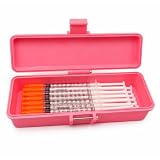
Prefilled Syringe Storage Box - Injection Organizer for 50 & 100 Unit Syringes | Insulin Syringe Case Holds 10 Syringes for Travel and Home Use | 180mm Internal Length, Case Only
How the TRT Units Converter Works
The TRT Units Converter provides two separate conversion tools. The first converts between milligrams and micrograms. The second converts between microliters and milliliters.
These conversions can help users read medication labels, prescriptions, concentration information, and liquid measurements more consistently. The converter performs unit conversion only and does not calculate an appropriate testosterone dose or treatment schedule.
1. Milligrams to micrograms
Milligrams and micrograms are units of mass commonly used on medication labels and prescriptions.
1 milligram = 1,000 micrograms
To convert milligrams to micrograms, multiply the milligram value by 1,000:
Micrograms = Milligrams × 1,000
Example:
0.5 mg × 1,000 = 500 µg
2. Micrograms to milligrams
To convert micrograms to milligrams, divide the microgram value by 1,000:
Milligrams = Micrograms ÷ 1,000
Example:
750 µg ÷ 1,000 = 0.75 mg
3. Microliters to milliliters
Microliters and milliliters are units of liquid volume.
1 milliliter = 1,000 microliters
To convert microliters to milliliters, divide the microliter value by 1,000:
Milliliters = Microliters ÷ 1,000
Example:
500 µL ÷ 1,000 = 0.5 mL
4. Milliliters to microliters
To convert milliliters to microliters, multiply the milliliter value by 1,000:
Microliters = Milliliters × 1,000
Example:
0.25 mL × 1,000 = 250 µL
5. Enter a value
Enter a non-negative number into the From field of the appropriate converter. The result appears automatically in the To field.
The converter accepts whole numbers and decimal values. Negative values are not supported because medication mass and liquid-volume measurements are not normally entered as negative quantities.
6. Switch the conversion direction
Select Switch Units to reverse the conversion direction.
For example, the mass converter can switch between:
- Milligrams to micrograms
- Micrograms to milligrams
The liquid-volume converter can switch between:
- Microliters to milliliters
- Milliliters to microliters
When a valid result is available, the converter moves that result into the new From field and recalculates it in the opposite direction.
7. Clear the converter
Select Clear to remove the entered value and result. Clearing also restores the converter to its original direction:
- Milligrams to micrograms
- Microliters to milliliters
8. Copy the result
Select Copy to copy the complete conversion to the clipboard.
For example:
0.5 milligram (mg) = 500 microgram (µg)
The Copy button remains unavailable until a valid conversion result is displayed.
9. Understanding mass and volume
Milligrams and micrograms measure mass. Milliliters and microliters measure liquid volume. They are not interchangeable measurements.
You cannot convert a medication amount in milligrams directly into milliliters unless the medication concentration is also known.
For example, knowing that a dose is 50 mg does not identify the liquid volume. You must also know the vial concentration, such as 200 mg/mL.
The volume would then require a separate calculation:
Volume in mL = Dose in mg ÷ Concentration in mg/mL
Example:
50 mg ÷ 200 mg/mL = 0.25 mL
The TRT Units Converter does not perform concentration-based dose calculations. Use the TRT Calculator for calculations involving a weekly dose, vial concentration, injection frequency, and liquid volume.
10. Verify the units carefully
Similar-looking unit abbreviations can represent very different quantities:
- mg means milligram
- µg or mcg means microgram
- mL means milliliter
- µL means microliter
A milligram is 1,000 times larger than a microgram, and a milliliter is 1,000 times larger than a microliter. Misreading one unit as another can create a major measurement error.
Important: This converter performs mathematical unit conversions only. It does not verify a prescription, recommend a dose, identify a syringe marking, determine an injection volume, or confirm that a medication is appropriate for you. Always compare the converted result with the original prescription, medication label, vial concentration, and instructions from a qualified healthcare professional or pharmacist.
Medical Disclaimer: This TRT Units Converter and the information on this page are provided for general informational and educational purposes only. They are not intended to provide medical advice, diagnosis, treatment recommendations, prescribing instructions, injection guidance, or advice about whether testosterone replacement therapy is appropriate for any individual.
The converter performs mathematical conversions between milligrams and micrograms and between microliters and milliliters. It does not convert medication mass into liquid volume unless a separate concentration calculation is performed, and it does not account for a medication’s prescribed dose, vial concentration, syringe calibration, injection schedule, or treatment instructions.
Results depend entirely on the value and conversion direction selected by the user. Incorrect entries, misunderstood unit abbreviations, misplaced decimal points, product-label differences, or confusion between mass and liquid-volume units may produce a dangerous or inappropriate result.
Do not use this converter to select a testosterone dose, change a prescribed dose, determine injection frequency, choose a syringe, identify an injection route, prepare medication, or replace instructions from a prescribing healthcare professional.
Always verify the medication name, prescription, unit abbreviation, vial concentration, liquid volume, syringe markings, and converted result with a qualified healthcare professional or pharmacist before preparing, measuring, or administering any medication.
Appsoup.com and the converter’s creators do not guarantee the accuracy, completeness, reliability, suitability, or safety of the converter or its results. They are not responsible for conversion errors, incorrect entries, medication errors, misuse, injuries, or decisions made based on the converter or information on this page. Use of the converter is at your own risk.